
If you’ve noticed that street signs or the text on your phone aren’t as sharp as they used to be, you’re not alone. Blurry vision is one of the most common reasons people see us, often related to common age-related vision changes. The 2 usual suspects are nearsightedness and farsightedness, but it can be tricky to tell them apart on your own.
The key difference between them is whether you have trouble seeing things far away or things up close. Nearsightedness makes distant objects blurry, while farsightedness makes close-up objects blurry. A comprehensive eye exam can help you know for sure what’s causing your vision changes.
What Is Nearsightedness (Myopia)?
If you have nearsightedness, also known as myopia, you can likely see your computer screen or a book just fine. It’s the distant objects—like a clock on the wall or a movie screen—that appear fuzzy. This happens when the shape of your eye causes light to focus in front of your retina instead of directly on it.
Common Signs of Nearsightedness
- Difficulty seeing road signs clearly while driving
- Squinting to try and focus on something far away
- Headaches that come from straining your eyes
- Eye fatigue, especially when playing sports or looking at distant objects
What Is Farsightedness (Hyperopia)?
On the flip side, farsightedness, or hyperopia, means you can see distant objects with ease. The challenge comes with tasks that are right in front of you, like reading a menu or sewing. This condition occurs when your eye focuses images behind the retina instead of on it.
Common Signs of Farsightedness
- Trouble focusing on your phone or a book
- Eye strain or headaches after doing close-up work
- Holding reading materials farther away to see the words clearly
- A general aching feeling in or around your eyes
How Age Relates to Farsightedness
Many people notice their near vision starts to change after age 40. This is a normal part of aging called presbyopia, and it happens because the lens inside your eye loses some of its flexibility. The symptoms feel a lot like farsightedness, making it tough to read small print without reaching for a pair of readers. These changes are something we check for during all adult and senior eye exams.
A Quick Look at Your Prescription and How Vision Changes
After an eye exam, your prescription gives us a detailed story about what your eyes need to see clearly and comfortably. The numbers and symbols are a simple code that tells us how to correct your vision. Understanding a couple of key parts can help you make sense of it all.
Plus or Minus Signs
A prescription with a minus sign (–) in front of the number, like –2.25, typically means you are nearsighted. A plus sign (+), such as +1.50, usually points to farsightedness. The number itself tells us the strength of the lens you need for sharp vision.
Can You Be Both Nearsighted and Farsighted?
It is possible to experience both, and it’s more common than you might think. This often happens when someone who has been nearsighted their whole life develops age-related presbyopia. The result is blurry vision both far away and up close, but special lenses like progressives can help correct vision at all distances.
Find Your Solution with an Eye Exam
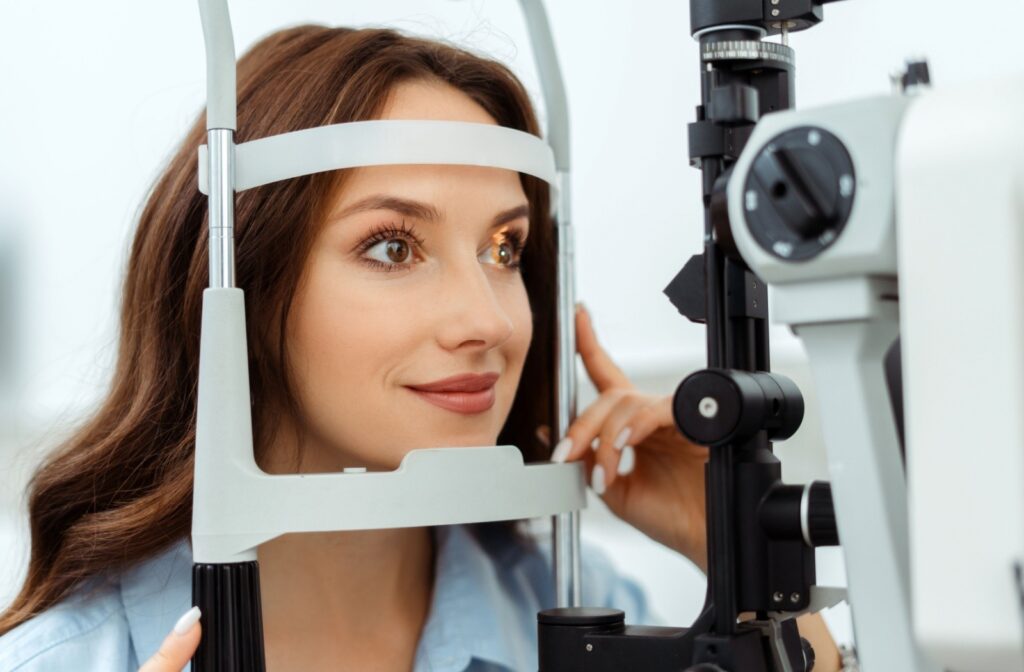
Guessing about your vision won’t get you the clarity you deserve. The only way to truly know which refractive error you have is with a comprehensive eye exam. This is a straightforward and comfortable process that gives us a complete picture of your eye health.
During your exam, we’ll use different lenses and charts to carefully measure your vision. We take the time to listen to your concerns and understand your daily visual demands. This evaluation helps us find the exact prescription you need to see your best.
Vision Correction Options for Your Lifestyle
Once we understand your needs, we can explore solutions that fit how you live and work. Modern eye care offers many options that go beyond simple vision correction. We focus on finding the right lenses to improve your daily life.
Eyeglasses for Style and Clarity
Lenses today can do amazing things. We can find options that reduce glare for safer nighttime driving or filter blue light to make screen time more comfortable. Progressive lenses are a popular choice, offering a smooth transition between near, intermediate, and distance vision without any lines. More and more of our patients are also choosing to add a task lens, which is ideal for anyone who spends time looking at arms length. Our patients who work in front of a computer find this beneficial. It can also help those who perform tasks such as quilting and woodworking, as well as other tasks.
The Freedom of Contact Lenses
If you prefer a glasses-free look, contact lenses can be a wonderful alternative. Technology has come a long way, and there are now comfortable options for most prescriptions. This even includes multifocal contacts that can correct both nearsightedness and farsightedness at the same time.
Myopia Management for Kids
For children, we’ve noticed that nearsightedness can sometimes worsen as they grow. Myopia management is an approach that uses specific eye drops, contact lenses, or glasses to help slow down its progression.
Take the First Step to Clear Vision
Understanding the difference between nearsightedness and farsightedness is the first step toward clearer vision. At St. Marys Optometry, we’re here to listen to your concerns and help you find the perfect solution for your eyes and your lifestyle. Book your comprehensive eye exam with our team today!